Chaattam
Also called Jumping Jackals · abstract strategy · 2 players
An abstract strategy game built on one movement: a peg crossing between two others. Jump over discs, sabotage your opponent, and be the last one standing.
Board game
Game design
Game mechanics
Gameplay
Design process
Three tissue paper balls
My first plan was a Formula 1 board game, car-shaped pegs racing round a circuit on dice rolls. I dropped it because the dice did the playing. Players had almost no say in what happened, and it felt passive.
So I started looking at movement with more thought in it, like the knight and the queen in chess. And an answer turned up. Playing with three small tissue paper balls, I moved one between the other two to make a triangle, and each ball could take its turn doing the same.
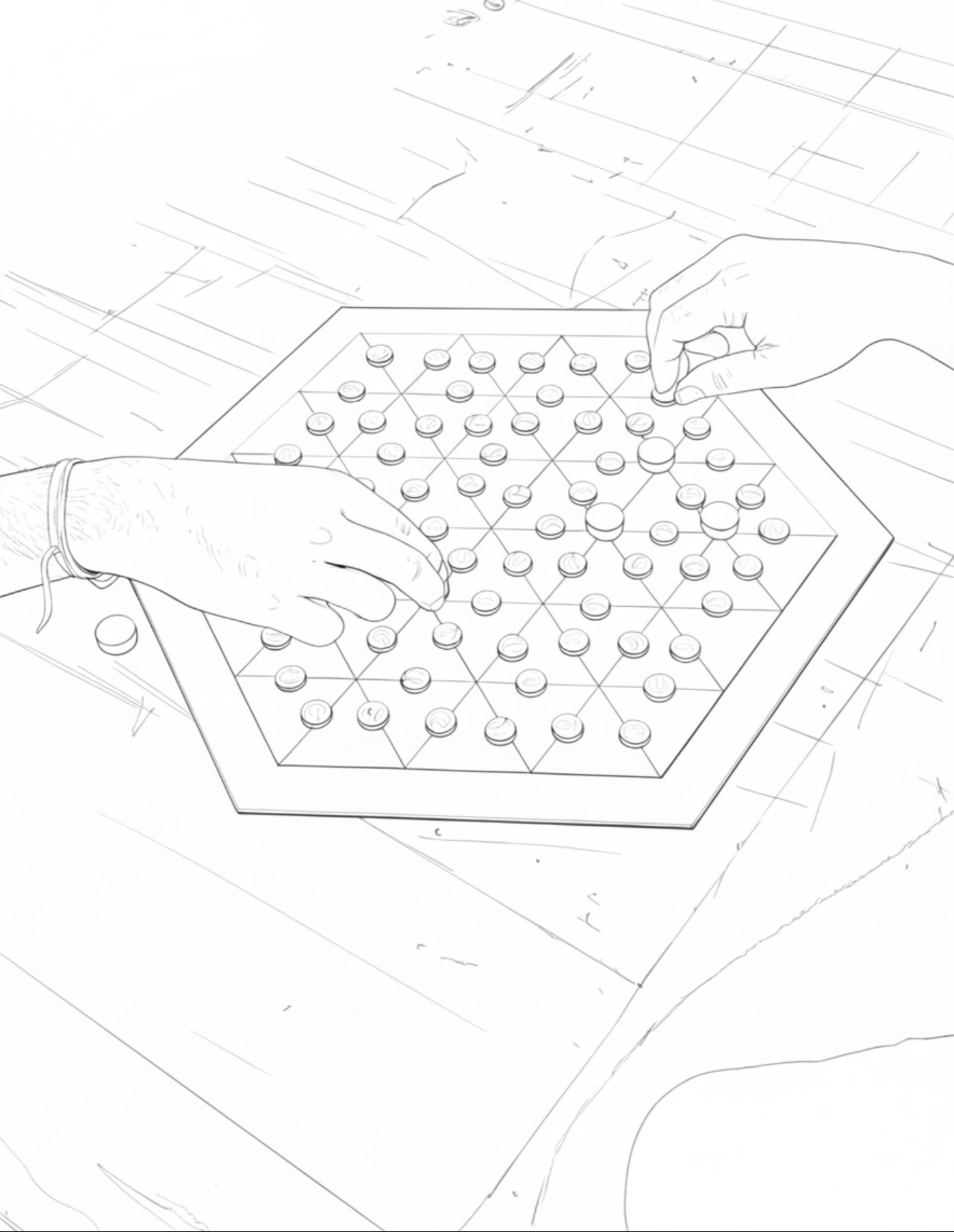
That crossing became the whole game. I tried shapes until a hexagon of equilateral triangles fit it, put the balls on the corners as pieces, and placed discs along the lines between them so every crossing has something to jump.
The core move: a peg crosses between two others, over the disc on the line they make, and takes it.
Rules
Last one standing
Discs aren't points. They show which paths are still open, and every jump closes one. You win by leaving your opponent with nowhere to go.
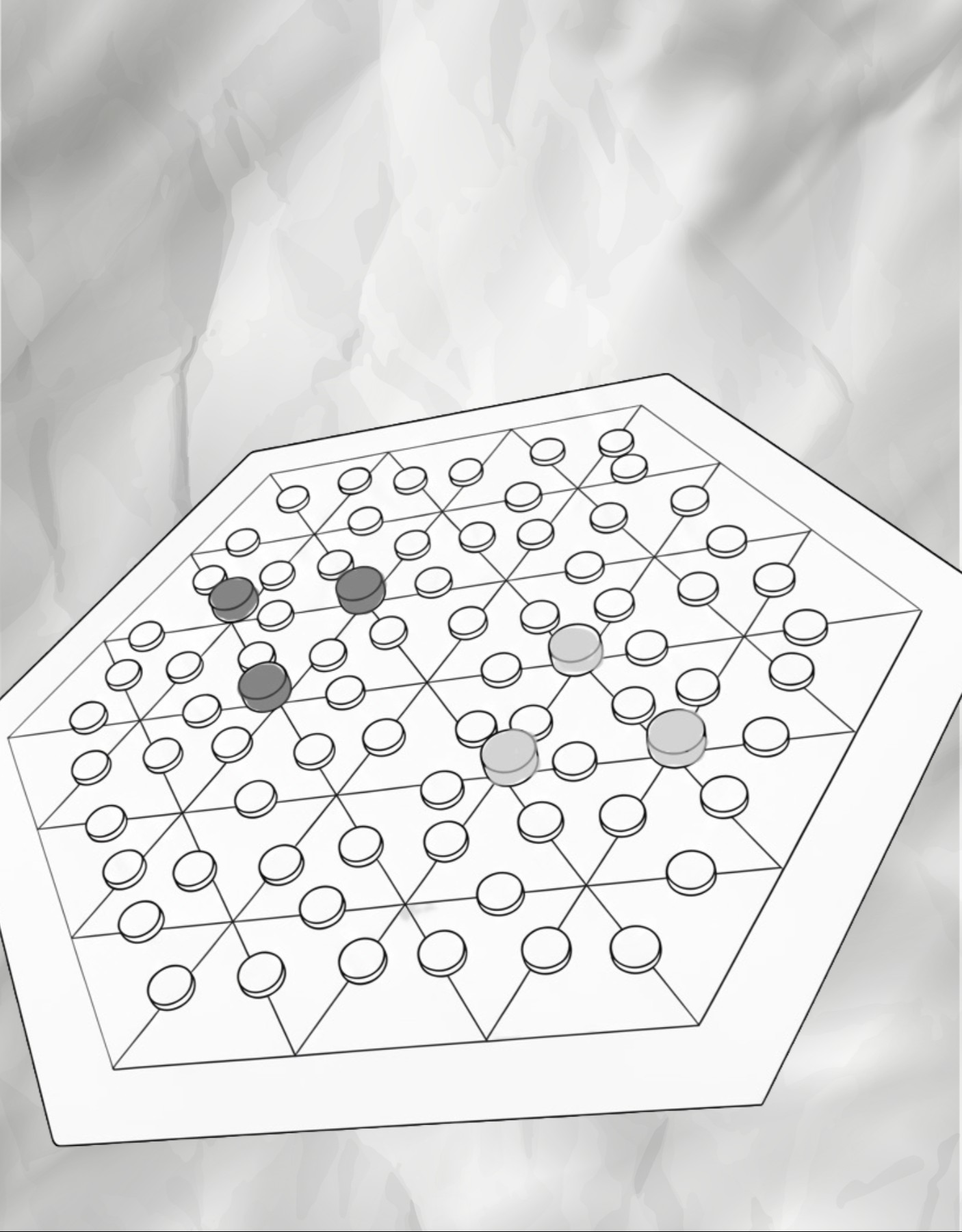
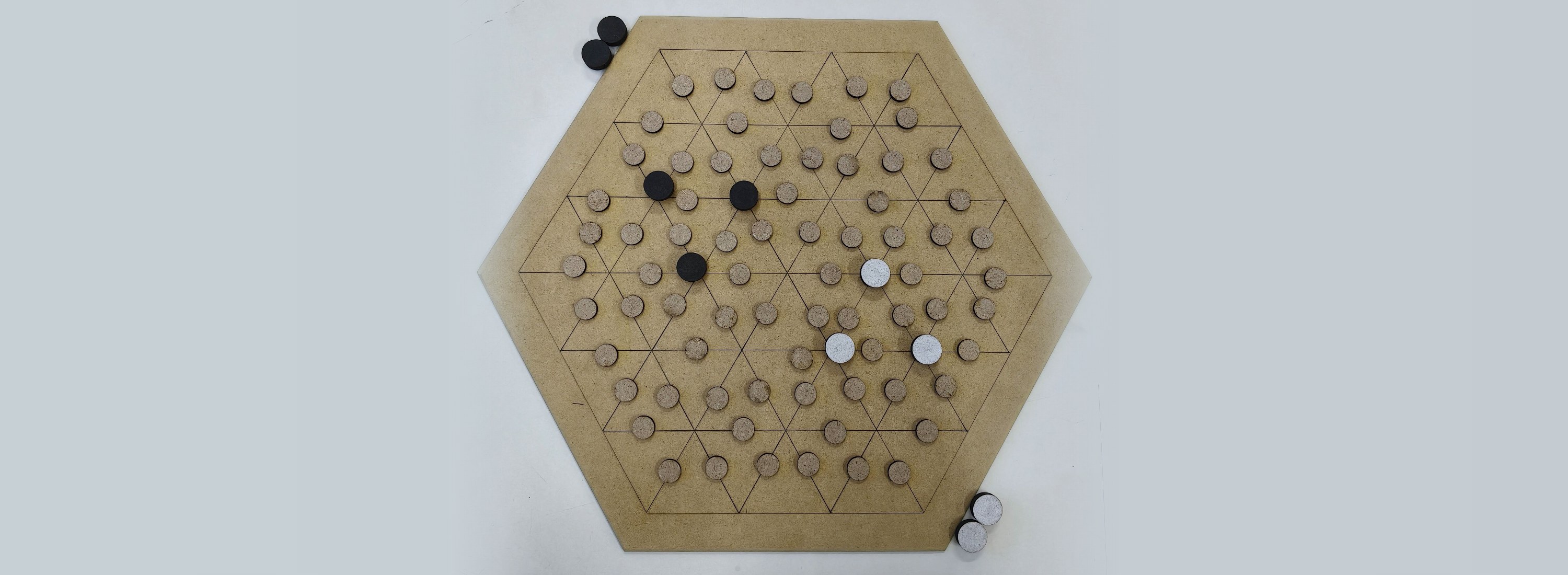
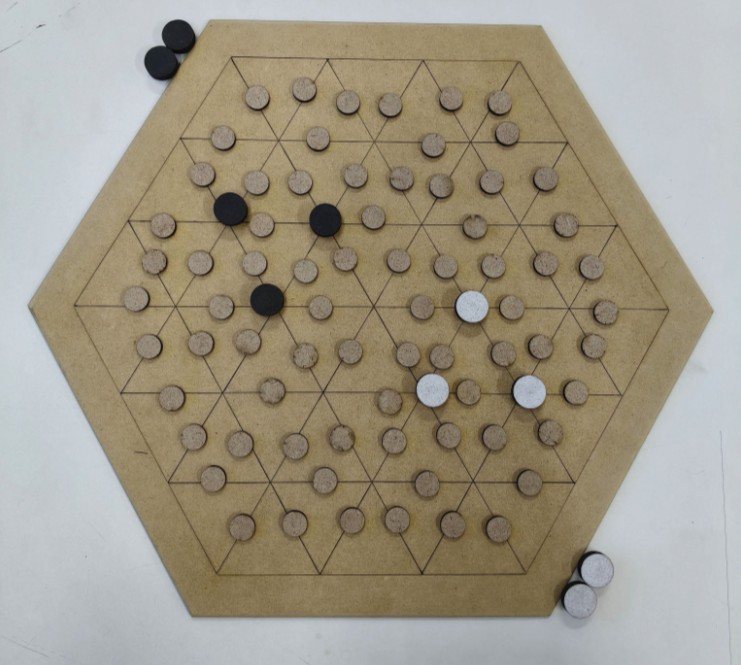
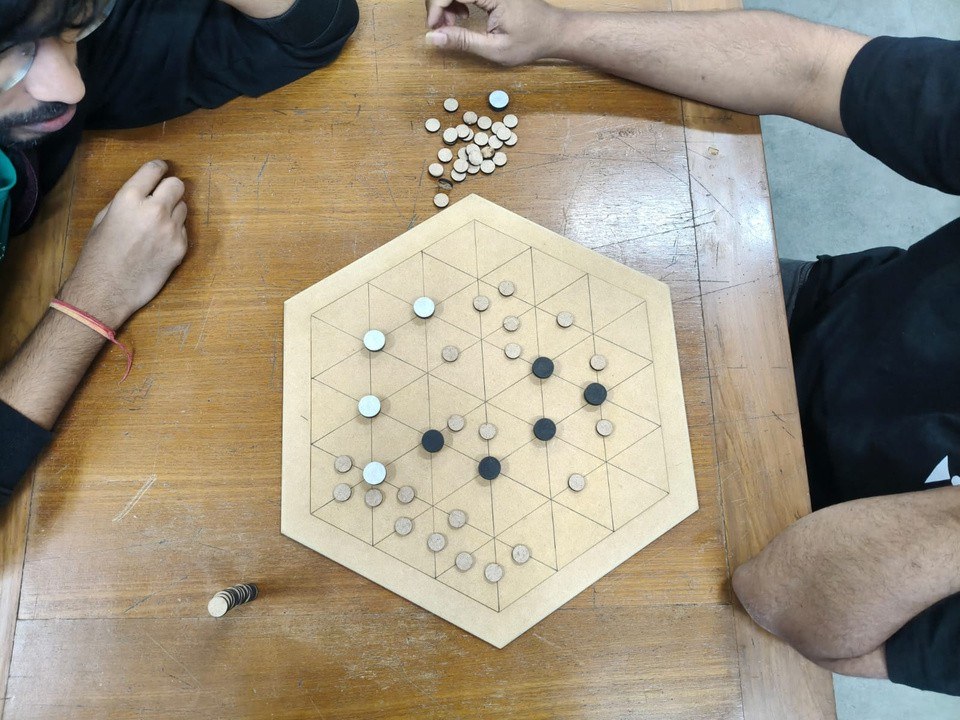
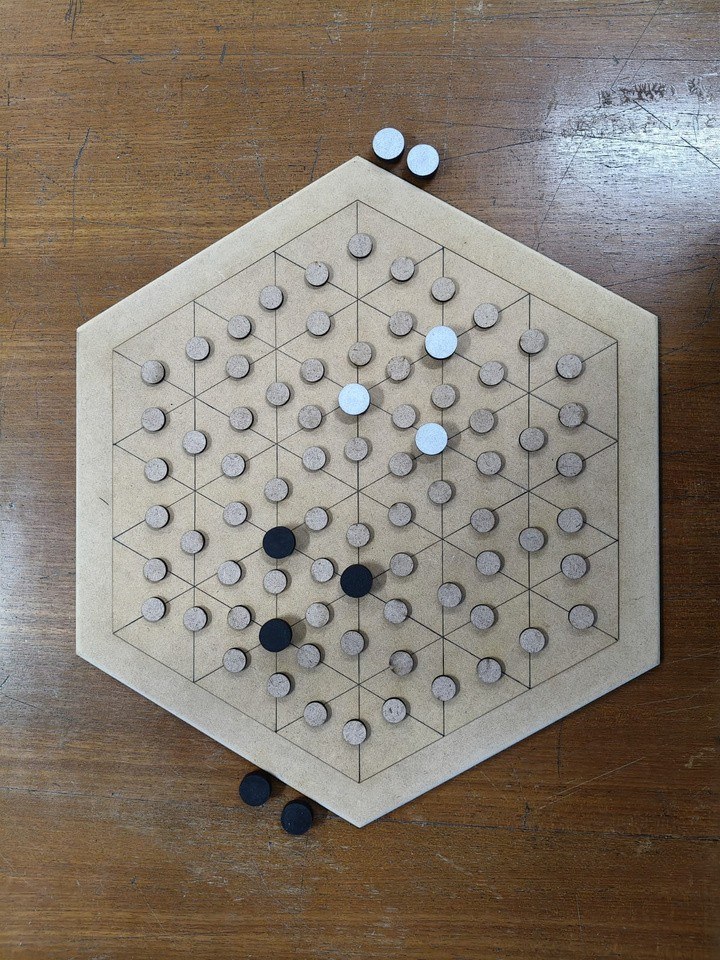
Starting setup: both players begin close together near the centre.
Setup
• The board is a hexagon made of 54 equilateral triangles.
• Discs sit on every inner line, never on the outer edge.
• Each player has five pegs: three start near the centre, two wait in reserve.
Movement
• Jump one of your pegs over a disc, along the line made by two other pegs. They can be yours or your opponent's.
• Take the disc and land just beyond it.
• You can never land on your opponent's peg.
Reserve pegs
• Instead of moving, place a reserve peg anywhere on the board.
• Placing a peg ends your turn.
End
• The game ends when a player has no legal move left. The other player wins.
Iterations
Finding the right board
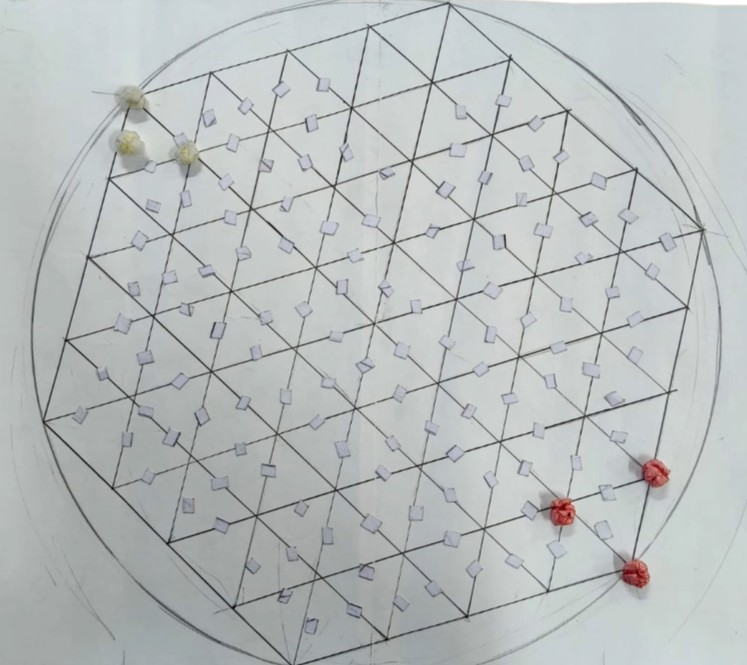
Four rounds of paper prototypes and seven playtests, each one fixing what the last one showed.
01
24 triangles
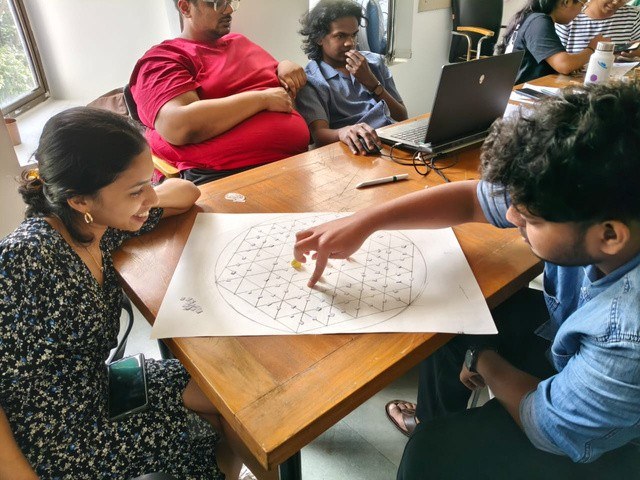
A hand-drawn board, pegs rolled from sticky notes, paper discs. Jump only between two pegs of your own colour; whoever takes the most discs wins.
Playtest
Whoever reached the centre first almost always won.
Next
Make the board bigger.
02
96 triangles
Same rules on a board four times the size, to open up the middle.
Playtest
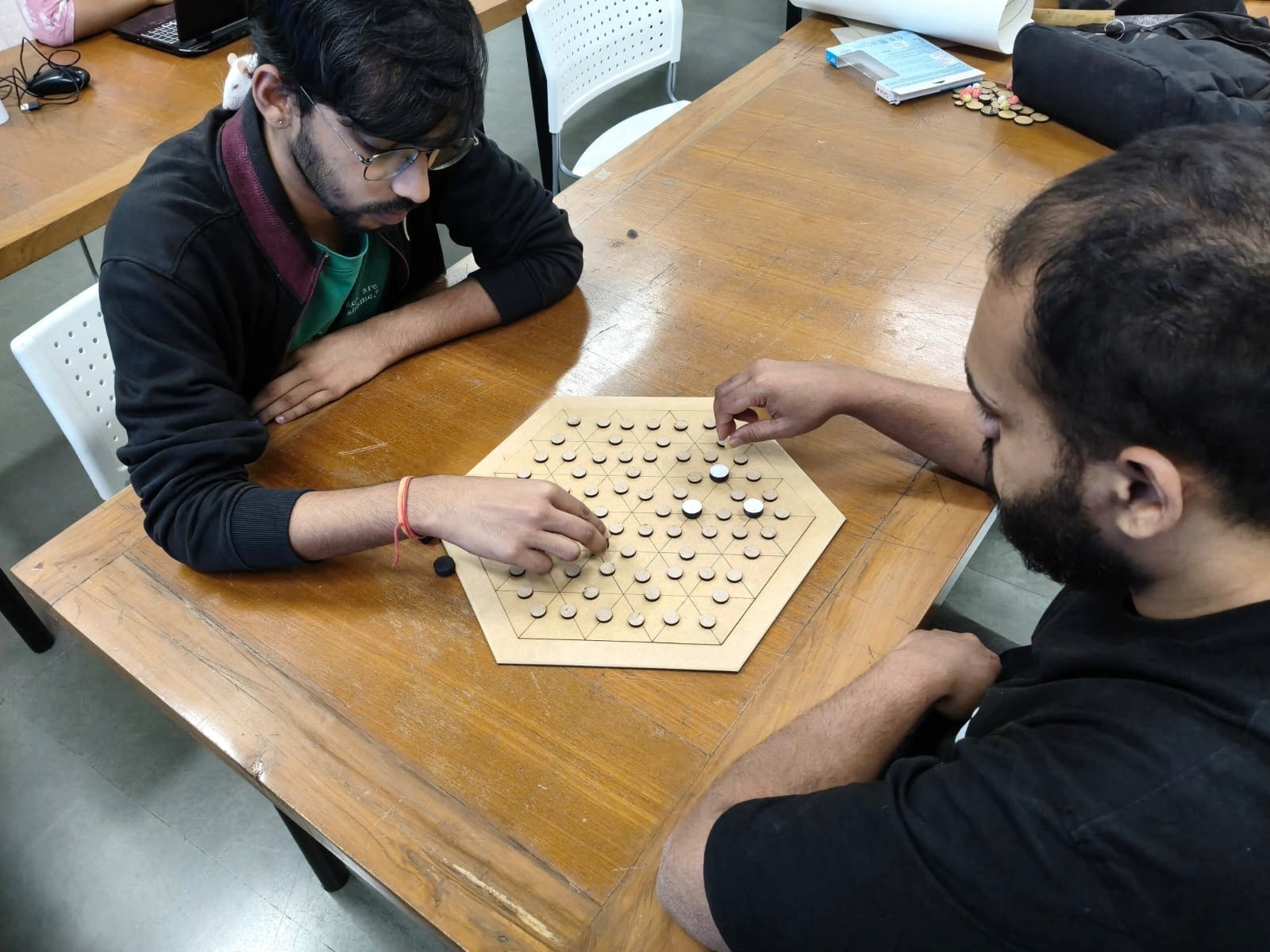
Too big. Players took ages to reach each other, and long stretches had no interaction at all.
Next
Shrink it to 54.
03
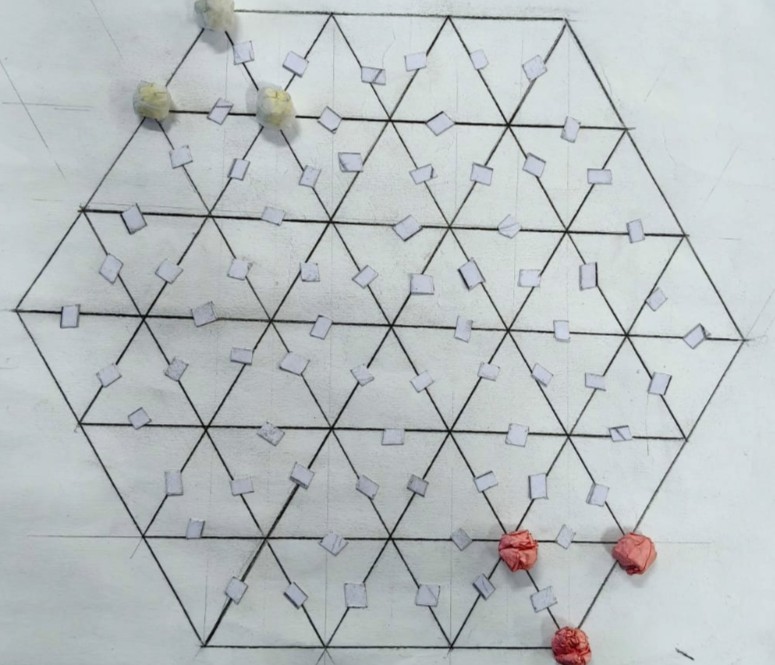
54 triangles
The middle ground. Players could finally think a few moves ahead.
Playtest
No clear goal: capture discs or trap your opponent? Too few pegs, too few choices.
Next
Tie the goal to the movement.
04
54 + reserve pegs
Two reserve pegs each, placed anywhere, and jumps can use your opponent's pegs too.
Playtest
Interaction jumped, but mostly late in the game.
Next
Make surviving the goal, and start in the centre.
Playtesting
Watching people play
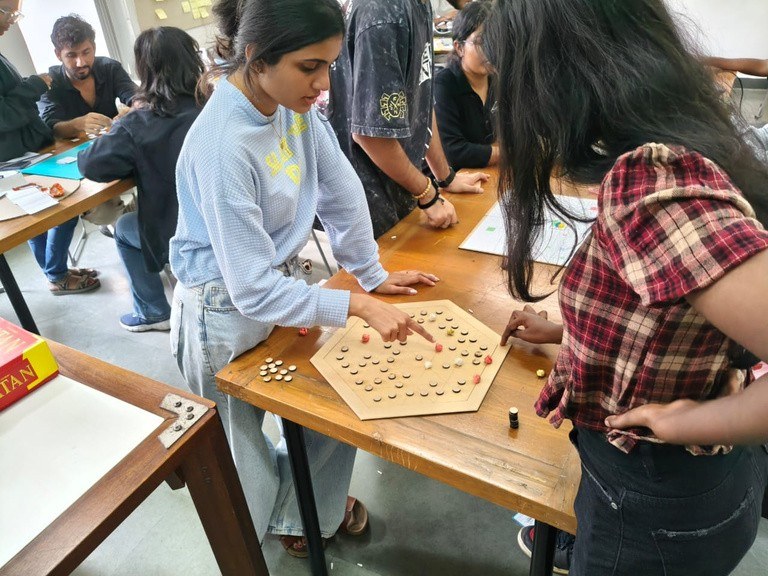
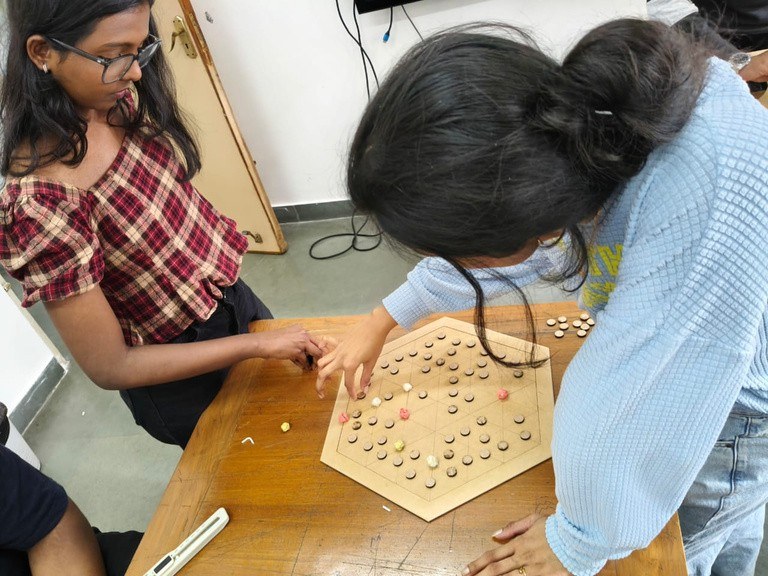
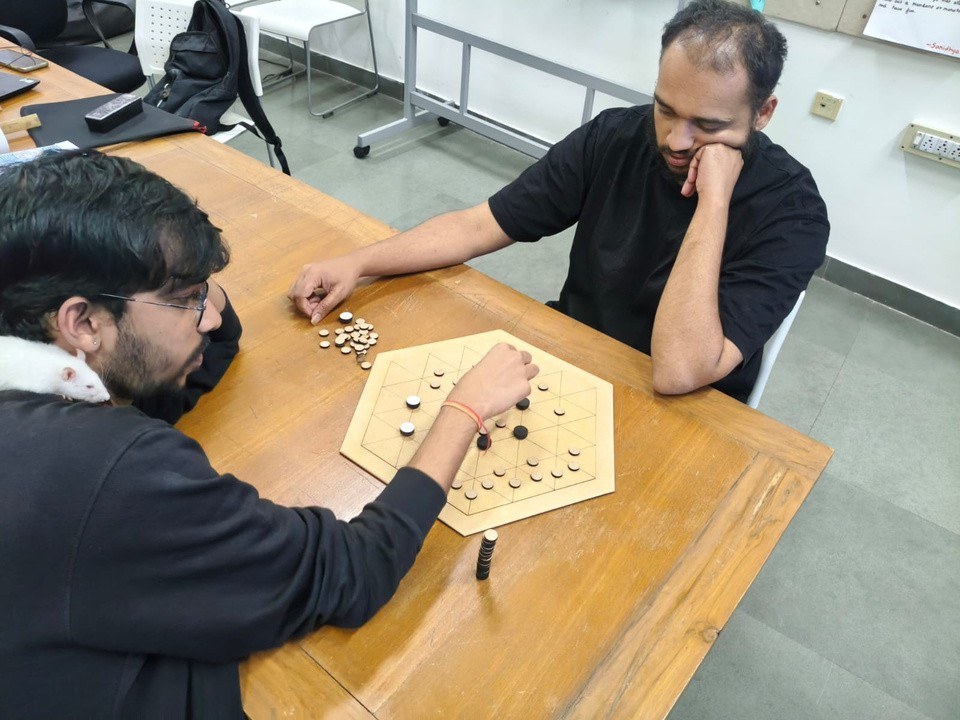
Each version went to classmates and new players for playtesting, and their feedback shaped it into the final prototype.
Prototype 1
Built in MDF
For the first proper prototype I cut the board and pieces from MDF and painted the pegs, so it could survive a lot of games.
Start in the centre
Both players begin near the middle, so they meet from the first moves.
Survive, don't collect
The goal moved from collecting discs to sabotaging your opponent and staying on the board longest.
Discs as paths
Discs became pure signals of where you can and can't move, no longer something to score.
Current stage
What players expect
New players still try to collect the discs, even though they only mark paths now. If collecting were the goal, there'd be a deeper problem: only one disc can be taken per turn, so both players end up with about the same number, and the score stops meaning anything.
Ways forward
01
Give it a theme
Players are jackals and the discs are sheep, so jumping one is a hunt with a story.
02
Two-coloured discs
A jumped disc flips to the jumper's colour, turning capture into territory.
03
Keep it as it is
The discs already do one clear job: showing the open paths.
At a glance
Evolution
Version
Triangles
Key change
What we found
Iteration 1
24
Same-colour jumps, most discs wins
The centre decides the game
Iteration 2
96
Same rules, bigger board
Slow, little interaction
Iteration 3
54
Balanced size
No clear goal, too few pegs
Iteration 4
54
Reserve pegs, jump with opponent's pegs
Interaction only late
Prototype 1
54
Centre start, survival goal, discs as paths
Players still want to collect
Reflection
One move, many games
Working on Chaattam taught me how simple rules and mechanics can create interesting strategic decisions. I learned how important it is to balance gameplay, encourage players to think ahead, and make the experience engaging without making the rules too complicated.
Get Template